In 2025, the International Association of Hydrogeologists (IAH) continued to advance global groundwater science, policy engagement, education, and professional collaboration through the work of its commissions and networks. These groups organised technical sessions at the IAH Congress in Melbourne, delivered training and outreach activities, partnered with international organisations, and contributed to research and policy development across multiple groundwater themes.
LUNA (Liaison with UN Activities) strengthened IAH’s role in global water governance by ensuring groundwater remains central to international policy discussions, particularly in the context of climate change. LUNA coordinated IAH’s involvement in UN World Water Day and the International Year of Glaciers Preservation, and co‑hosted a webinar with UNESCO IHP on groundwater and transboundary aquifers. IAH President Teodora Szocs contributed to high‑level discussions at UNESCO’s 50th Anniversary of the Intergovernmental Hydrological Programme and 60 years of UNESCO Water Sciences. LUNA was also represented IAH at the UN Water Conference in New York.
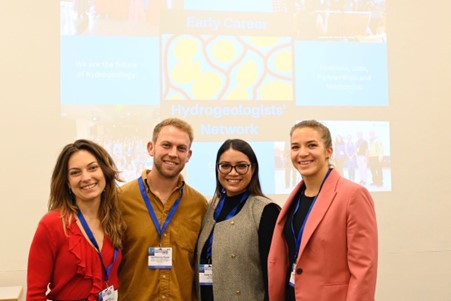
At the Melbourne Congress, the Early Career Hydrogeologists’ Network partnered with the UNESCO Groundwater Youth Network to host an inter-generational debate session, fostering dialogue between emerging and established professionals.
The Commission on Groundwater and Climate Change played a major role at the Congress, organising four technical sessions featuring 47 speakers. The Commission is preparing a special issue of Frontiers in Water and Climate focused on groundwater and climate change. It actively seeks contributions on publications, research and education projects, media articles, upcoming events and policy developments.
The Commission on Regional Groundwater Flow (RGFC) hosted a global session on regional groundwater flow systems at the Congress, showcasing diverse research approaches. The session included a tribute to the late Professor Joel Carrillo‑Rivera, recognising his lasting influence on the field. The RGFC also launched a new lecture series to promote dialogue and collaboration on emerging research in regional groundwater flow.
The Commission on Groundwater Quality (GQC) launched a global Groundwater Quality Capacity Survey to identify challenges, capacity gaps, and regional disparities faced by hydrogeologists working in groundwater quality. Responses will support global efforts to strengthen groundwater quality monitoring, policy, and professional capacity.
The Urban Groundwater Network reported on the AWARD project, a Horizon Europe initiative (2024–2027) aimed at integrating alternative water resources into urban planning. The Bucharest Demo Case at Circus Lake seeks to understand groundwater–surface water interactions and test nature‑based solutions for stabilising lake levels and improving urban water resilience. The project’s methods and metrics are being designed for replication across European cities.